How to Teach Nepali Alphabet to Your Child: A Fun, Easy Guide for Parents
Introduction
Learning to teach Nepali alphabet at home is easier than you think. Do you want your child to read and write in Nepali? Teaching the Nepali alphabet is the first big step. It opens the door to books, prayers, family letters, and a lifelong connection to Nepali culture.
Many Nepali parents feel this deeply — especially families living in the USA, Canada, the UK, Australia, Japan, and the Middle East. Your child may speak English all day at school. At home, you want them to know Ka, Kha, Ga too.
The good news? Little children learn languages fast and easily. With a few minutes of fun practice each day, most kids can learn the alphabet in a joyful, stress-free way.
This guide is simple, warm, and made for busy parents. You do not need to be a teacher. You just need love, patience, and a little bit of play. Let’s begin.
What Is the Nepali Alphabet?
The Nepali language is written in a script called Devanagari. This is the same script used for Hindi, Sanskrit, and several other languages.
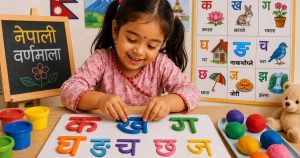
The Nepali alphabet is called the Varnamala (वर्णमाला), which means “garland of letters.” It has two main parts:
- Swar (स्वर) — the vowels. These are the open sounds like a, aa, i, ee, u, oo. There are about a dozen vowels in the standard chart.
- Vyanjan (व्यञ्जन) — the consonants. These are sounds like ka, kha, ga. There are around 36 consonants in the traditional school chart, though the exact count varies depending on how conjunct letters are counted.
Children usually begin with the famous consonant series: Ka, Kha, Ga, Gha, Nga. It is the most familiar and the easiest to sing.
Here is a small starter table you can use at home:
| Letter | Sound | Example Word | Meaning |
|---|---|---|---|
| क | Ka | कलम (kalam) | pen |
| ख | Kha | खरायो (kharaayo) | rabbit |
| ग | Ga | गाई (gaai) | cow |
| घ | Gha | घर (ghar) | house |
| ङ | Nga | नाकथोप्ले | a soft nasal sound |
Tip: The letter ङ (Nga) is a nasal sound that rarely starts a word. Don’t worry if your child finds it tricky. Just teach the sound gently and move on.
Why Learning Nepali Matters for Diaspora Families
If you live outside Nepal, teaching your child Nepali is a beautiful gift. It helps them:
- Talk with grandparents, uncles, and aunts back home.
- Feel proud of who they are and where they come from.
- Read Nepali stories, songs, and festival greetings.
- Stay connected to Nepali culture, food, and values.
Research on bilingualism, summarized by organizations such as the American Speech-Language-Hearing Association, generally shows that children can learn two or more languages at the same time without harm — and that a strong home language often supports learning at school. UNESCO also promotes mother-tongue learning through International Mother Language Day, celebrated every February 21.
In short: keeping Nepali alive at home is healthy, smart, and loving.
The Best Age to Start
Every child is different, but here is a friendly age guide many parents find helpful:
| Age | What to Focus On |
|---|---|
| 2–3 years | Listening to Nepali songs and sounds; naming everyday objects |
| 3–4 years | Learning vowels and the Ka, Kha, Ga rhythm through songs |
| 4–6 years | Recognizing letters; matching letters to pictures |
| 6–8 years | Writing letters; reading simple two-letter words |
| 8–10 years | Reading short sentences and small storybooks |
Do not rush. Early years are about love for the language, not perfect writing.
How to Teach the Nepali Alphabet Step by Step
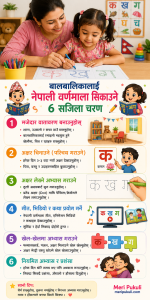
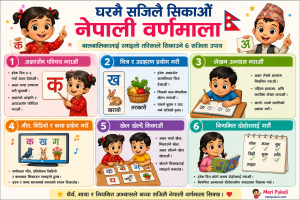
Here is a simple plan to teach Nepali alphabet that any parent can follow.. Aim for just 5 to 10 minutes a day. Short and happy beats long and boring.
Step 1 — Sing the alphabet.
Children remember music better than plain words. Sing Ka, Kha, Ga, Gha, Nga like a fun tune. Repeat it while cooking, driving, or walking.
Step 2 — Show one letter at a time.
Do not teach all letters in one day. Pick one letter. Say its sound. Show a picture that starts with it.
Step 3 — Connect letters to real objects.
Point to a ghar (house) for घ. Point to a gaai (cow) in a book for ग. Real objects make letters stick.
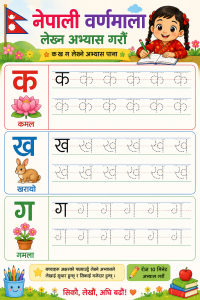
Step 4 — Trace and write.
Let your child trace big letters with a finger first, then a crayon. Big, messy letters are perfectly fine at the start.
Step 5 — Play games.
Turn learning into play. Hide letter cards around the room and go on a “letter hunt.” Kids love it.
Step 6 — Review a little every day.
A quick five-minute review beats a long lesson once a week. Small daily practice wins.
Fun Activities Parents Can Do at Home
You do not need fancy tools. Try these low-cost, high-joy activities:
- Letter treasure hunt: Hide paper letters and ask your child to find “क.”
- Playdough letters: Roll dough into the shape of letters. Great for little hands.
- Sand or flour tray: Let your child draw letters with a finger in a tray of flour.
- Sticker charts: Give a sticker for each letter learned. Celebrate progress.
- Kitchen learning: Name Nepali foods — dal, bhat, roti — and find their first letters.
- Bedtime Nepali stories: Read short Nepali picture books together every night.
- Festival practice: During Dashain and Tihar, write simple greetings together.
Real example: One family in Sydney turned their fridge into a letter board. Each week they added one new magnetic Nepali letter. By the end of the year, their five-year-old could sing the whole vowel chart. Small steps add up.
Safety Tips and Common Mistakes to Avoid
Screen-time safety tips:
- Choose slow, calm videos with clear Nepali sounds.
- Watch together when possible, so learning feels shared.
- Follow healthy screen-time habits; the American Academy of Pediatrics suggests limiting screen use for young children and favoring interactive, co-viewed content.
- Always turn on parental controls on YouTube and learning apps.
- Balance screens with real books, cards, and hands-on play.
Common mistakes parents make:
- Teaching too many letters at once. One at a time is enough.
- Comparing your child to others. Every child learns at their own speed.
- Making it feel like school. Keep it playful, not stressful.
- Skipping daily practice. A tiny bit every day beats a lot once a month.
- Correcting too much. Praise effort first, fix gently later.
- Giving up early. Language learning is a marathon, not a sprint.
Learning benefits at a glance:
- Stronger memory and focus.
- Better connection with family and culture.
- Early reading confidence.
- Pride in a bilingual identity.
- A gateway to Nepali songs, festivals, and stories.
Conclusion
When you teach Nepali alphabet to your child, you give them a lifelong gift. Teaching your child the Nepali alphabet is one of the most loving things you can do as a parent. It is not about being perfect. It is about spending happy little moments together — singing Ka, Kha, Ga, tracing letters, and sharing stories.
Start small. Stay patient. Make it fun. Celebrate every letter your child learns.
Whether you live in Kathmandu, Toronto, London, or Tokyo, you are keeping something precious alive. You are handing your child a piece of home. And one day, when they read a letter from their grandparents in Nepali, you will know every joyful five-minute lesson was worth it.
Frequently Asked Questions (FAQs)
1. What is the best age to teach the Nepali alphabet?
Most children do well starting between ages 3 and 5. But you can begin exposure earlier with songs and sounds. Older children can learn quickly too, so it is never too late.
2. How long does it take a child to learn the Nepali alphabet?
It varies. With five to ten minutes of fun practice most days, many children recognize most letters within a few months. Focus on enjoyment, not speed.
3. My child was born abroad and speaks only English. Can they still learn Nepali?
Yes, absolutely. Children can learn two languages at the same time. Speaking Nepali at home and practicing letters through play makes it natural and fun.
4. Should I teach vowels (swar) or consonants (vyanjan) first?
Many teachers start with vowels because they build the sounds for everything else. But the Ka, Kha, Ga song is also a great, motivating starting point. Either works.
5. Do I need to buy special books or apps?
No. You can start with homemade letter cards, playdough, and everyday objects. Books and apps are helpful extras, not requirements.
6. What if my child gets frustrated?
Stop and switch to a game or a song. Keep sessions short and positive. Frustration usually means the lesson is too long or too hard for that day.